

Whether in the castle or in the town, residential buildings had to have a minimum of natural lighting. Windows were therefore desirable, while ensuring that they did not constitute too easy entry points for possible attackers. In Poilvache, they were therefore arranged in places theoretically impossible to access from the outside. They are most often of the « bench » type, that is to say comprising a bench built into the masonry and allowing you to sit while looking at the landscape. The Brèche des Patriotes was originally one of these windows.
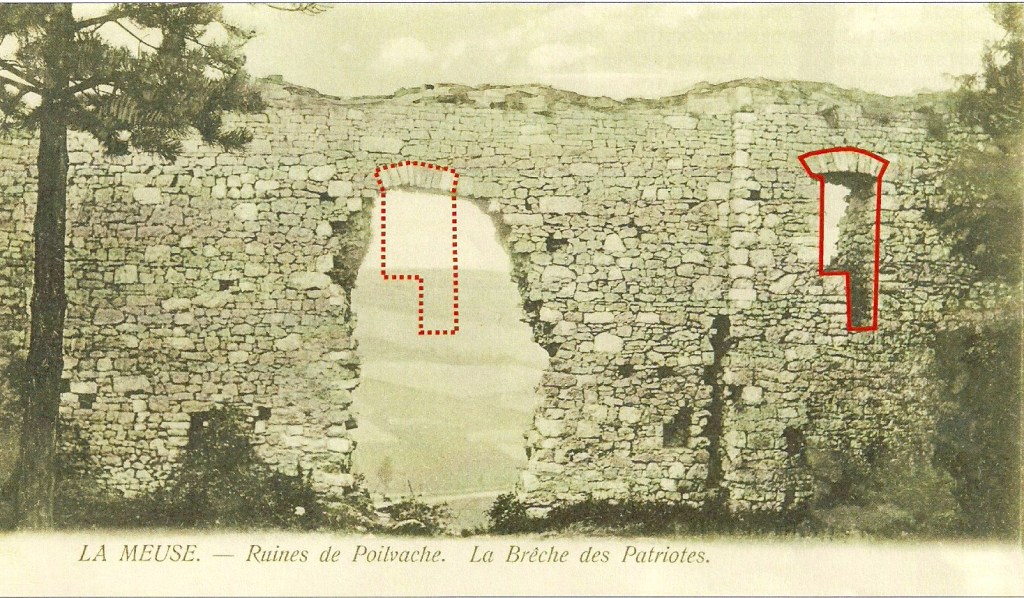
In 1790, during the Brabançonne revolution in 1790, the surroundings of Namur and the Meuse valley were the subject of more or less intense fighting. The “Patriots”, under the orders of an English officer Koehler, occupied the left bank of the Meuse from Hastière as far as Namur. The Austrians re-occupied, from the summer of 1790, a large part of the territories located south of the Meuse. It is Austrian troops who occupy the Poilvache site, benefiting from a beautiful dominant position to shell the Belgians camped at Anhée. These are the troops who would have breached the enclosure from a window seat (see old postcards) in order to position a cannon there and shell Patriots. Even if no archives corroborate this hypothesis, the Memoirs of Vilain XIIII, a ball found in the enclosure, the illustrations of the album De Croÿ, of Vilain XIIII and of Vitzthumb seem to confirm this thesis.
In the 1980s, for safety reasons, the DNF and the Archeology Department lowered the wall that connected the two parts of the enclosure to prevent children and visitors from falling.
This part of the ruins was again the scene of some fighting during the campaign of May 1940. German troops also used the site to destroy the last pockets of Allied resistance on the left bank of the Meuse (at the time of the crossing of the Meuse by the panzers of Werner and Rommel on May 12, 1940).





 Poilvache