
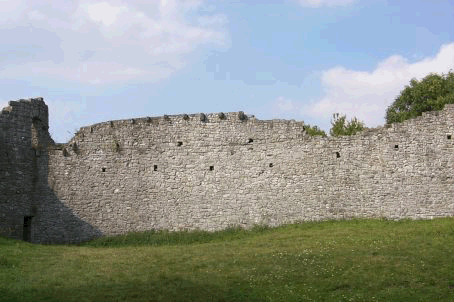
Located between the West Tower (on the left of the photo) and the view point towards Champalle and Yvoir (on the right), this well-preserved section of wall allows us to better understand the original architecture of the place.
The northern and western flanks of the fortress are naturally protected from any attack by the configuration of the terrain. Any attempt to launch assaults on these sides would have been difficult, if not impossible, due to the significant slope of the terrain and the cliff. However, the occupants of Poilvache nevertheless considered it essential to fortify these two areas, not only undoubtedly to increase the effectiveness of the defense but also to provide incomparable possibilities of observation and control.
The walls built reached a height probably between 6m and 9m. Their thickness is only 1.50 m, which can be explained by the fact that the risks of destruction by artillery were very low, if not zero. Indeed, from the 13th century to the beginning of the 15th century, siege machines were mainly pendulum machines which projected stone balls at a distance of 50m to a little over 200m. For them to have a minimum of effectiveness, due to their weight and handling, they must be installed on flat ground, which was absolutely impossible on the north and west sides of Poilvache. In such conditions, it was not necessary to build very thick curtain walls. Their summit will simply be equipped with a walkway whose weight will be supported by crows. Many of these remain. The protection of the garrison was certainly supplemented by a parapet or battlements.
In the wall, we can still see bolt holes: the very high enclosure could only be built with hand oil and ladders allowing the builders to raise it to 3-4 m in height. A little ingenuity must be added: the bolt holes are used to attach scaffolding and sloping floors to mount the stones as the wall is built.
The question of what was done with it after the construction of the wall remains open: decoration? Roof support?
A dendrochronological analysis by P. Hoffsumer made it possible to date some pieces of oak beams preserved in these log holes: they date from 1325.
The beautiful space which extends in this corner of the fortress was retained by the Order of the Provost of Poilvache to hold its annual Chapter. It is here, in spring, in the shadow of the walls, that the inductions of new members of the Order take place each year, in recognition of the services rendered to the Provost!





 Poilvache